Sizing a battery energy storage system (BESS) for peak shaving is fundamentally a two-variable exercise, and treating it as one number ("we need a 500 kWh battery") is the most common mistake procurement teams make before they come to a manufacturer for a quotation. The two variables are power, measured in kilowatts (kW), and energy, measured in kilowatt-hours (kWh). Power tells you how much of your site's demand spike the system can absorb at any instant; energy tells you for how long it can keep absorbing it before it runs out. A system that is strong on power but short on energy will clip the top off a demand spike for a few minutes and then let the grid take over anyway, defeating the purpose of the investment. Getting both numbers right, together with the supporting parameters below, is what separates a BESS that actually reduces a utility bill from one that merely sits in a yard.
Start with the load profile, not the battery
Every credible sizing exercise begins with interval load data from the site, ideally at 15-minute resolution over at least twelve months so that seasonal peaks are captured. From that data you are looking for three things: the magnitude of the demand peaks above your target ceiling, how long each peak typically lasts, and how often peaks recur during the billing period. A site that spikes to 800 kW for ten minutes twice a month has a very different sizing problem to one that sits at 750-820 kW for two hours every weekday afternoon. The former may be handled with a small, fast-responding system; the latter needs sustained energy delivery and will cycle the battery far more often, which matters for cycle-life planning.
Once you know the shape of the peak, you can define a shaving target: the demand ceiling you want the utility meter to see. The difference between the actual peak and the ceiling gives the power requirement, and that difference multiplied by duration gives a first approximation of the energy requirement.
Power and energy: the two ratings that define the system
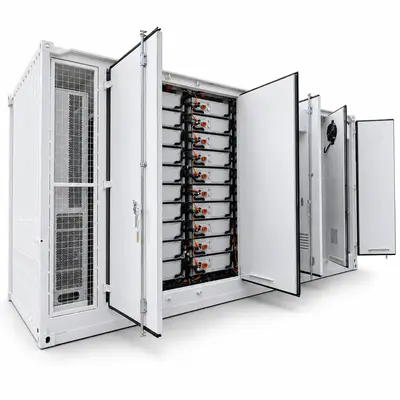
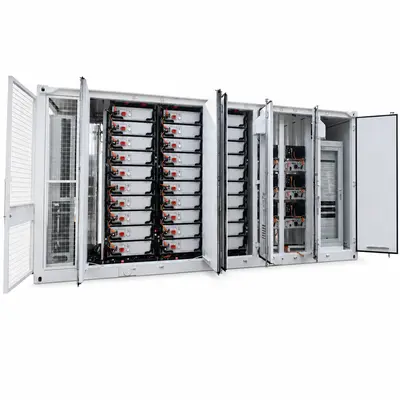
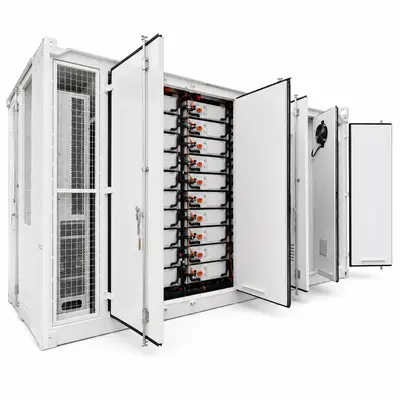
The power rating (kW) of a BESS is set by its power conversion system (PCS) — the inverter stack that interfaces the DC battery to the AC site network — and by how much continuous current the battery cabinets can safely deliver. The energy rating (kWh) is set by the number and configuration of battery cells and packaged as a nameplate capacity for the containerised or cabinet-based system.
A useful shorthand for relating the two is the C-rate, which describes how fast a battery is charged or discharged relative to its capacity. A 1C rate means the battery could theoretically discharge its entire nameplate capacity in one hour; a 0.5C rate means it takes two hours to fully discharge at rated power. Most commercial liquid-cooled LFP cabinets are designed around 0.5C because it suits the 1-4 hour peak durations typical of commercial demand profiles, and because moderate discharge rates are kinder to cell temperature and long-term cycle life than aggressive high-C designs. At 0.5C, a system's kWh nameplate is roughly twice its kW rating — a 150 kW / 300 kWh cabinet, for example — a helpful check when a quotation looks unbalanced.
Usable capacity versus nameplate capacity
Nameplate kWh is not what you get to use. Four factors sit between the number on the datasheet and the energy actually available on a working day:
| Factor | Typical effect |
|---|---|
| Depth of discharge (DoD) | LFP systems are commonly operated to 90-95% DoD to protect cycle life, leaving a reserve band unused |
| Round-trip efficiency | Liquid-cooled LFP systems typically return 88-92% of the energy put in, the balance lost to conversion and thermal management |
| Auxiliary loads | Cooling pumps, fans, BMS and controls draw a small parasitic load that reduces net export |
| End-of-life derating | A system is normally sized so that even after years of cycling and capacity fade it still meets the duty at end of life, not only on day one |
A project that needs 300 kWh of usable energy at end of life, once these factors are applied, will typically require a nameplate installation in the region of 360-400 kWh — the exact figure depends on the DoD policy and efficiency assumptions used, and a competent supplier will show this arithmetic explicitly in a proposal rather than quoting nameplate capacity as if it were delivered energy.
Cycle life, degradation and augmentation
LFP cells used in Millenium's liquid-cooled cabinets are rated for approximately 6,000 cycles to a defined end-of-life capacity threshold (commonly 80% of original capacity), which is a major reason LFP chemistry dominates stationary commercial storage today. For a peak-shaving application cycling once per working day, 6,000 cycles corresponds to well over fifteen years of operation before augmentation would be needed, though actual fade also depends on operating temperature, average DoD and calendar ageing. Because capacity declines gradually rather than stopping abruptly, well-designed systems are sized with headroom so that the shaving target is still met in year ten, not just year one, and the cabinet-based architecture allows additional units to be added later (augmentation) if load growth or accelerated degradation warrants it, rather than requiring a full system replacement.
Tariff structure drives the target, not just the equipment
The size and shape of the ceiling you are shaving against comes directly from your tariff. Two structures matter most. Demand charges bill for the single highest kW (or kVA) reading in a billing period, sometimes with a ratchet that carries a high peak into future months' minimum billing — under this structure, shaving even a short, sharp spike can be worth pursuing because the entire month's demand charge hinges on one interval. Time-of-use (TOU) energy tariffs instead charge different rates per kWh across the day; here the battery's value comes from charging during cheap off-peak windows and discharging during expensive on-peak windows, which is an energy-arbitrage function that can run alongside peak shaving on the same hardware. Most commercial projects combine both: the demand-charge saving justifies the power rating, while TOU arbitrage improves the return on the energy capacity that is sitting idle outside the daily peak window.
PCS sizing and grid connection
The PCS must be rated for at least the peak power the site needs shaved, with margin for reactive power support if the system is also expected to assist power factor correction. Grid connection requirements — protection relay settings, anti-islanding, point-of-common-coupling metering, and any utility interconnection approval — should be scoped early, since they can affect both the PCS specification and the overall project timeline more than the battery selection itself. For sites with an existing MV supply, the BESS is typically connected via a dedicated LV or MV switchgear bay, and coordinating this with the site's existing switchgear and protection scheme is worth doing at the same time as capacity sizing rather than as an afterthought.
Worked example: shaving 300 kW for two hours
Take a site with a recurring weekday afternoon peak that rises 300 kW above the target billing ceiling for approximately two hours. A first-pass sizing works as follows:
- Power requirement: 300 kW, so the PCS is specified at 300 kW (with modest margin, say 330-350 kW, to cover measurement and response-time tolerance).
- Raw energy requirement: 300 kW × 2 hours = 600 kWh of delivered energy.
- Correcting for round-trip efficiency (approximately 90%): 600 ÷ 0.90 ≈ 667 kWh drawn from the battery.
- Correcting for depth of discharge (operating to 92% DoD): 667 ÷ 0.92 ≈ 725 kWh of usable nameplate capacity needed.
- Building in end-of-life headroom (allowing for capacity fade over the design life): a nameplate installation in the region of 800-850 kWh would typically be proposed.
At a 0.5C design point, an 800 kWh nameplate system pairs naturally with a roughly 400 kW PCS, comfortably covering the 300 kW target with margin, and this is the kind of configuration that would arrive as a standard liquid-cooled cabinet grouping rather than a bespoke build. The exact split between number of cabinets, PCS units and controls would be finalised once the site's actual interval data and tariff structure are reviewed.
What to send for a quotation
To move from this kind of first-pass arithmetic to a firm proposal, a supplier needs: twelve months of 15-minute (or better) interval load data; the site's tariff structure, including demand charge basis and any TOU rate schedule; the desired demand ceiling or shaving target; site voltage and available space for outdoor or indoor cabinet placement; ambient climate conditions (temperature range, humidity, coastal or dusty environment); and any grid-connection or utility approval requirements already known. With that information a proposal can specify PCS rating, nameplate and usable energy capacity, expected cycle life under the site's actual duty, and a projected demand-charge or TOU saving.
Talk to Millenium
If you have interval load data and a demand-charge or TOU tariff you want to model, send it to jensen@millenium-electric.com or via WhatsApp on +86 175 0213 9434 and our engineering team will return a sized proposal covering PCS rating, usable capacity and expected cycle life for your site.