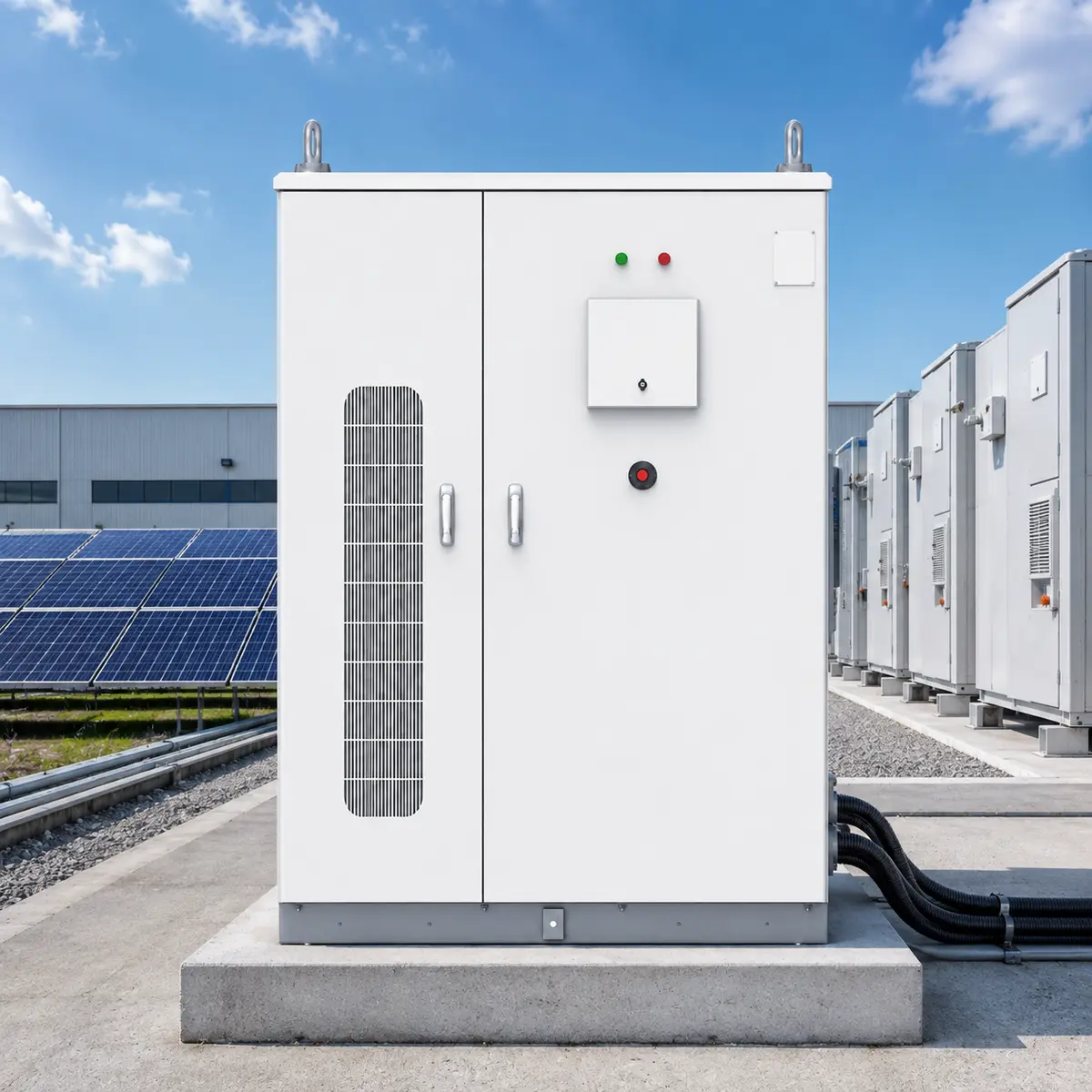
Every commercial or utility-scale battery energy storage project eventually reaches the same specification decision: liquid-cooled or air-cooled cabinets. The choice affects cycle life, footprint, noise, auxiliary power draw, maintenance routine and upfront cost, and it is not a decision that should be made by chemistry alone — the same LFP cell can be packaged either way, and the right answer depends on system size, climate, duty cycle and how much floor or roof space the project can spare.
Why cell temperature uniformity matters more than average temperature
The headline reason liquid cooling has become the default for larger LFP systems is not that it makes cells colder on average — it is that it makes them more uniform. In an air-cooled cabinet, airflow naturally favours cells nearest the inlet, so cells at the back or top of a stack run measurably warmer than those at the front. Under repeated cycling, this uneven temperature distribution causes uneven capacity fade: the warmer cells age faster than the cooler ones, and because cells in a series string are electrically bound to whichever cell is weakest, the whole string's usable capacity and cycle life end up limited by its hottest, fastest-ageing member. A liquid-cooled system circulates coolant through cold plates in direct contact with the cells, and because liquid carries heat far more effectively than air, well-designed liquid cooling typically holds cell-to-cell temperature spread within a few degrees Celsius across an entire cabinet, even under sustained high-power cycling. That uniformity is the main reason liquid-cooled LFP cabinets are commonly rated for around 6,000 cycles to end of life under realistic duty, and it is also why augmentation planning is more predictable — a pack that ages evenly is a pack whose remaining capacity can be forecast with confidence.
Energy density and footprint
Liquid cooling's compact cold plates and tighter thermal management allow cells to be packed more densely than an air-cooled design, which needs internal air channels and fan clearance built into the cabinet volume. In practice this means a liquid-cooled cabinet delivers more kWh per square metre of footprint and per cubic metre of enclosure volume than an equivalently sized air-cooled unit. For projects with generous outdoor space this difference may not matter much; for rooftop installations, urban substations, or sites where every square metre of container yard is costed against the project, the density advantage of liquid cooling can materially change the site layout and even the number of cabinets needed.
Auxiliary power, noise and site suitability
Air cooling relies on fans to move a high volume of air across cells, and moving air is inherently noisier and less power-efficient per unit of heat removed than circulating a liquid coolant through a closed loop with pumps. Well-designed liquid-cooled systems generally draw less auxiliary power as a percentage of throughput and run noticeably quieter than fan-cooled equivalents at comparable thermal duty — a relevant factor for installations near occupied buildings, residential boundaries or noise-sensitive commercial sites. Air cooling also draws ambient air directly into the enclosure (even when filtered), which makes it more exposed to dust ingress in arid or industrial environments and to salt-laden air in coastal locations, both of which accelerate contamination of electronics and connectors over time. Liquid-cooled cabinets, by contrast, are commonly built to IP55 or better as sealed enclosures with internal coolant loops, so the internal electronics are far less exposed to the external atmosphere — a meaningful advantage in hot, dusty or coastal climates where an air-cooled cabinet would need more frequent filter service and closer inspection for ingress.
Maintenance: different tasks, not necessarily more of them
Neither approach is maintenance-free, but the tasks differ. Air-cooled cabinets need their intake and exhaust filters checked and cleaned or replaced on a regular schedule, since a clogged filter both starves cooling airflow and lets more unfiltered dust past the remaining gaps. Fans themselves are wear items and eventually need replacement. Liquid-cooled cabinets instead require periodic checks of coolant level and coolant quality (concentration and contamination), inspection of the closed loop for leaks, and pump condition checks. Neither routine is onerous when scheduled properly, but a maintenance team used to air-cooled electronics should budget time to learn the liquid-loop inspection points rather than assuming the sealed enclosure means no maintenance at all.
Safety considerations
Cooling method is one input into a system's overall safety design, not a substitute for it. Both liquid-cooled and air-cooled LFP systems can be engineered to meet IEC 62619 safety requirements for stationary battery installations, covering cell and module safety, protection against short circuit and overcharge, and requirements around thermal propagation. Large-format testing regimes such as UL 9540A (evaluated in general terms here, without asserting a specific certification) assess how a system behaves in a thermal runaway event and whether propagation to neighbouring modules can be contained — this is a system-level design outcome that depends on cell chemistry, module partitioning, venting design and fire suppression provisions, not on cooling method alone. That said, better temperature uniformity does reduce the likelihood of any single cell reaching a thermal-runaway trigger point under normal operating stress, so liquid cooling is generally regarded as a favourable contributor to the overall safety case for larger, harder-cycled systems, even though it does not by itself constitute the safety design.
Cost
Liquid-cooled cabinets carry a higher upfront cost than air-cooled equivalents of the same nameplate capacity, reflecting the cold plates, pumps, coolant loop, heat exchanger and more sophisticated thermal control electronics involved. Air cooling remains materially simpler and cheaper to manufacture. Whether the liquid-cooled premium is worth paying depends on system size and duty: for a small cabinet cycled lightly in a temperate climate, the cycle-life and density advantages of liquid cooling may never be fully exploited, making air cooling the more cost-effective choice. For a larger system cycled daily, sited outdoors in a hot or coastal climate, or space-constrained, the longer service life, smaller footprint and lower long-run auxiliary consumption of liquid cooling typically offset the higher initial cost over the project's operating life.
When air cooling is still the right call
Air cooling is not an inferior technology to be phased out — it is the right choice for a meaningful share of projects. Smaller cabinets (in the tens of kWh rather than hundreds), installations in mild or well-controlled indoor climates, systems with light or infrequent cycling duty (for example backup power that rarely discharges deeply), and projects where upfront budget is the dominant constraint are all well served by a properly designed air-cooled cabinet. The key is matching the ambient environment and duty cycle to the cooling method's strengths rather than defaulting to liquid cooling as a blanket "premium" choice regardless of application.
Comparison at a glance
| Factor | Liquid-cooled | Air-cooled |
|---|---|---|
| Cell temperature uniformity | Typically within a few degrees across the pack | Wider spread, especially in larger stacks |
| Energy density / footprint | Higher kWh per m² and per m³ | Lower, due to airflow clearance needs |
| Auxiliary power draw | Generally lower per kWh of throughput | Higher, fan-driven |
| Noise | Lower | Higher |
| Outdoor / coastal / dusty suitability | Strong, commonly IP55-rated sealed enclosures | Requires more frequent filter service and inspection |
| Maintenance tasks | Coolant level, quality, leak checks | Filter cleaning/replacement, fan condition |
| Upfront cost | Higher | Lower |
| Best fit | Larger systems, daily cycling, constrained space, harsh climates | Smaller systems, mild climates, light cycling, tighter budgets |
Talk to Millenium
Whether your project points toward a liquid-cooled or air-cooled cabinet, send us your target capacity, site climate and expected cycling duty at jensen@millenium-electric.com or via WhatsApp on +86 175 0213 9434 and our engineers will recommend the configuration that fits.