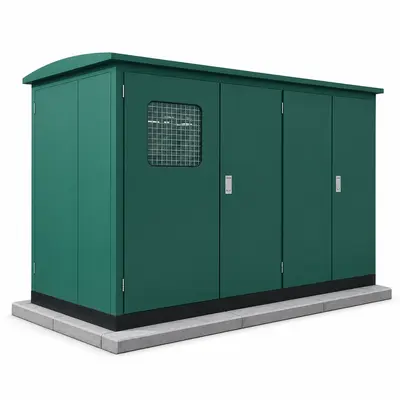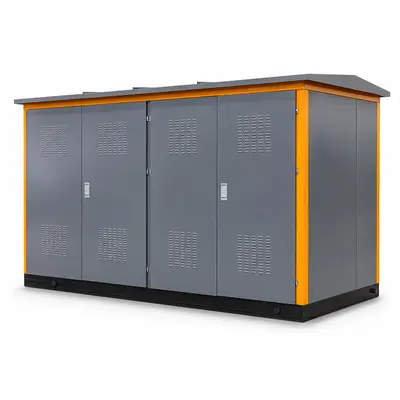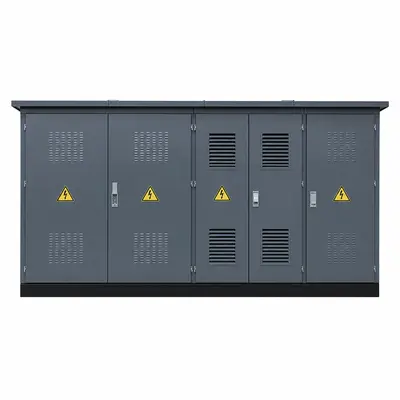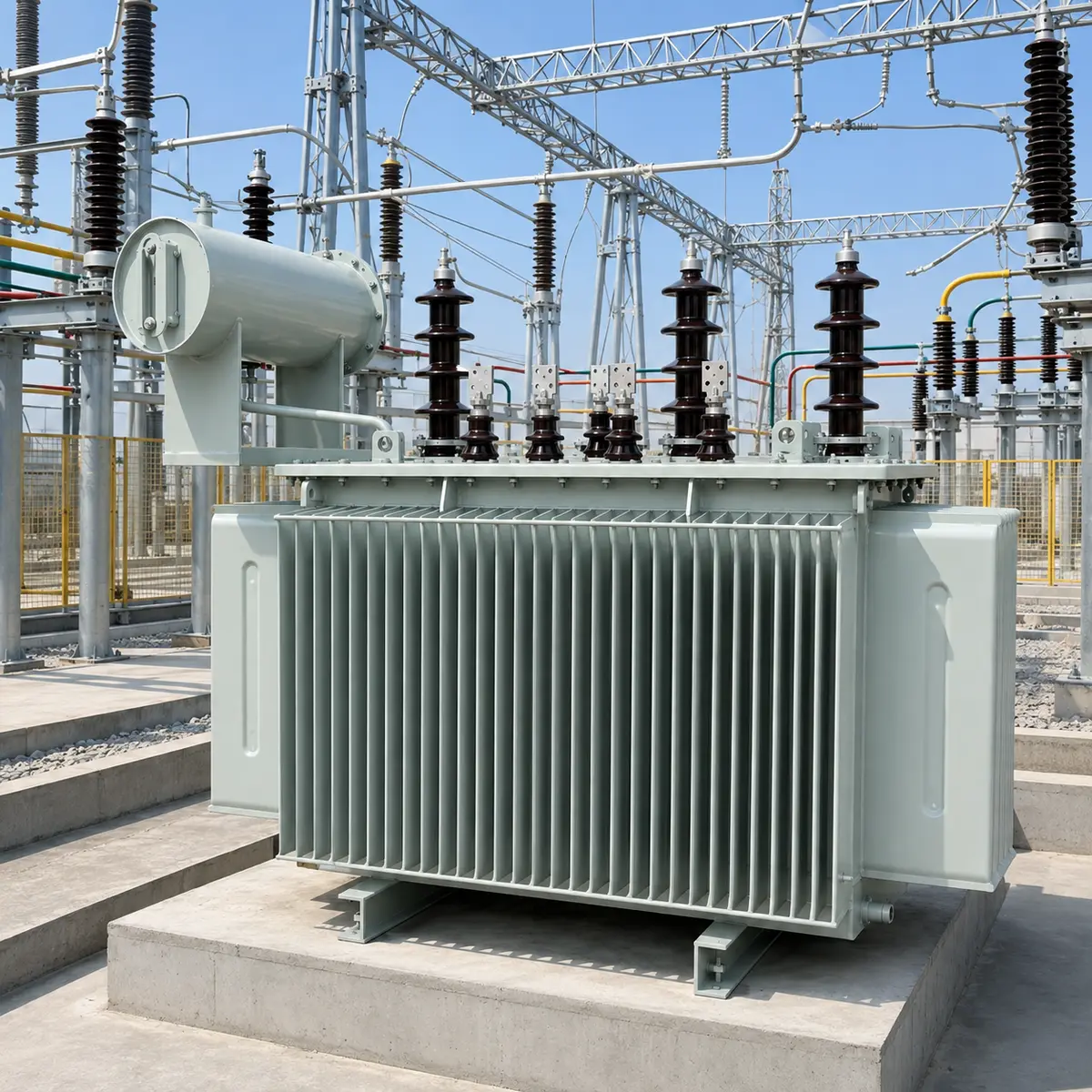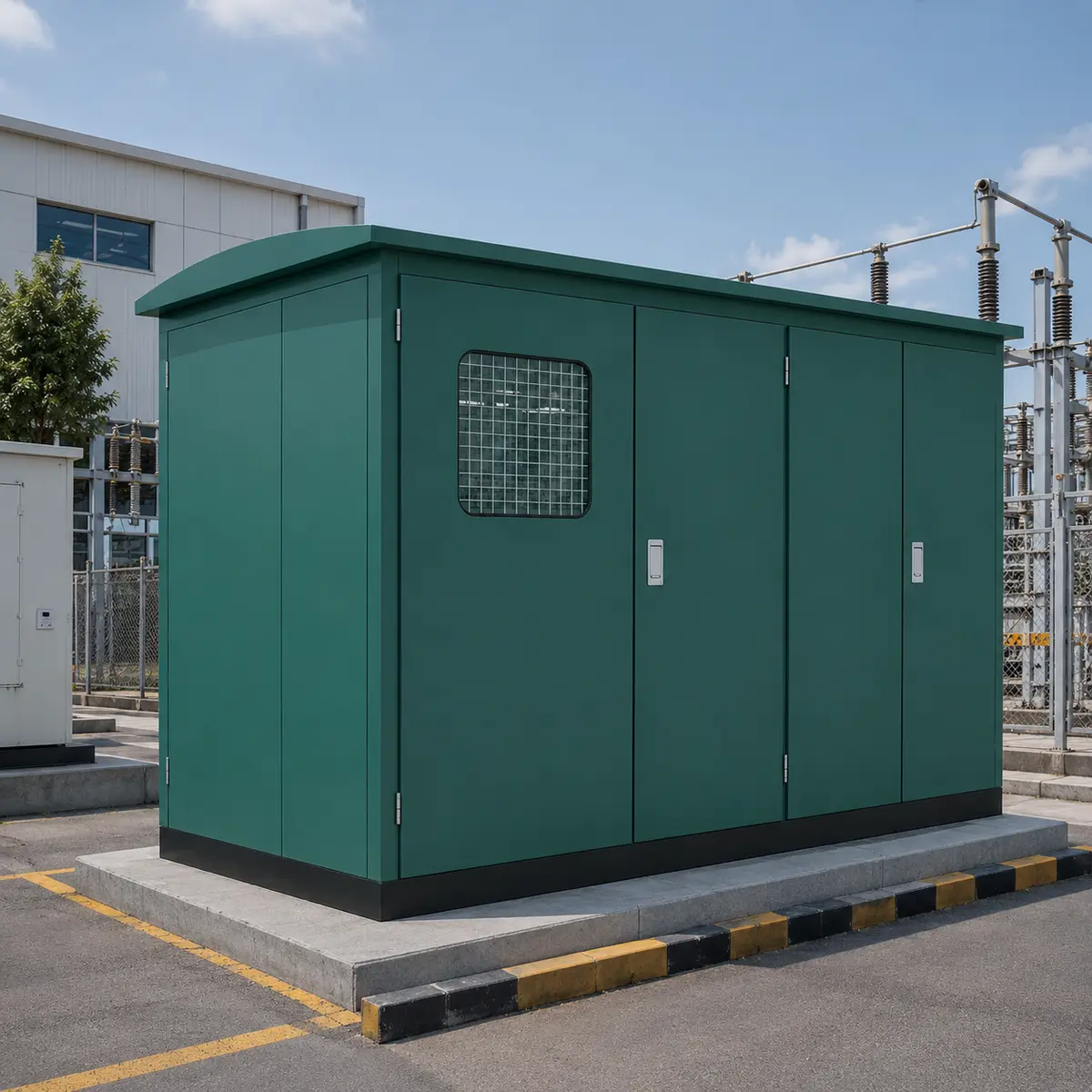
Compact, prefabricated substations combining medium-voltage switching, a transformer and low-voltage distribution in one factory-built enclosure have become the standard way to bring MV/LV transformation to sites that cannot accommodate a traditional brick-built substation: shopping centres, residential developments, industrial plants, and increasingly solar and wind farms. Two broad design philosophies dominate the market worldwide, generally described as European-style and American-style, and while both achieve the same basic function, they differ enough in construction, footprint, maintenance approach and typical application that choosing the wrong one for a project can create real operational friction.
The European three-compartment model
The European-style compact substation, governed by IEC 62271-202, is built around three physically separated compartments within a single steel or concrete enclosure: a medium-voltage compartment housing a ring main unit (RMU) or MV switchgear (commonly SF6-insulated or, increasingly, alternative-gas or air-insulated designs) with incoming and outgoing MV switches and a transformer-protection switch or fuse-combination unit; a transformer compartment housing an oil-immersed or cast-resin dry-type transformer; and a low-voltage compartment housing the LV distribution panel with outgoing feeders, metering and protection. This compartmentalisation is deliberate: it allows the MV switchgear, transformer and LV panel to be serviced, replaced or isolated largely independently, and it contains an internal arc fault to the compartment in which it originates rather than allowing it to propagate through the whole unit, provided the enclosure carries the appropriate internal arc classification (IAC) under IEC 62271-202/IEC 62271-200.
IEC 62271-202 also defines enclosure performance through several classification systems that matter directly to a buyer: the degree of protection (IP rating) against dust and water ingress, the internal arc classification (which walls of the enclosure are arc-resistant, and to what fault current and duration), and critically the temperature-rise class, which governs how much the enclosure itself is permitted to raise the ambient temperature seen by the transformer and switchgear inside it under full load - a real constraint in hot climates or where the substation sits in direct sun with limited ventilation, and a parameter worth confirming explicitly rather than assuming a generic "compact substation" rating covers it.
The American pad-mounted model
The American-style approach, most visible in pad-mounted transformers, takes a different design philosophy: rather than separating switching, transformation and LV distribution into distinct compartments, the MV switching function is integrated directly into the transformer tank itself. A pad-mounted transformer presents a dead-front, tamper-resistant enclosure at ground level with loop-feed primary bushings and elbow connectors (per IEEE 386) allowing underground MV cable to loop from one transformer to the next, internal MV switches or bay-o-net/CSP-style fusing for transformer protection, and a low-voltage compartment for secondary connections, all within a single tank rather than three separate compartments. This design grew out of North American underground residential distribution (URD) practice, where a very large number of small, unobtrusive, low-maintenance units needed to be installed with minimal footprint and no exposed live parts, and it remains the dominant convention for that application across the USA, Canada and markets that follow ANSI/IEEE practice.
Footprint, cost and maintenance trade-offs
Footprint is usually smaller for a pad-mounted unit than for a full three-compartment European-style substation of equivalent rating, since the pad-mount design eliminates the separate MV switchgear compartment and its clearances, which is precisely why it suits dense residential and commercial underground distribution where space at each service point is minimal and units are visually unobtrusive. The European three-compartment design, in exchange for a larger footprint, offers more MV switching flexibility (multiple ring main positions, easier future network reconfiguration, straightforward addition of ring extensions) and generally simpler independent maintenance of each function, since a fault or required service in the LV panel, for example, does not require de-energising or opening the transformer or MV compartment.
Cost comparisons depend heavily on rating, local labour costs and the specific configuration required, so no universal rule holds, but as a general pattern, pad-mounted units tend to be more cost-effective for single-transformer, radial-feed applications at lower ratings, while European-style compact substations tend to offer better value where MV ring switching, multiple feeders, or future network flexibility are genuinely needed, since that functionality would otherwise require separate external switchgear alongside a simpler transformer.
Maintenance philosophy differs correspondingly. A pad-mounted transformer, being a largely sealed, low-maintenance unit by design, suits utilities that prefer to minimise site visits and treat the unit as replace-rather-than-repair at end of life. A European-style compact substation, with its separable MV switchgear, transformer and LV compartments, suits organisations that prefer to service or upgrade one function without disturbing the others, and that have staff trained on RMU and LV panel maintenance as distinct disciplines.
Climate, renewables and mobile applications
Climate resilience considerations differ modestly: pad-mounted units, being fully tank-integrated and IP-rated as a whole, handle flooding, dust and coastal exposure well provided the enclosure and gasket specification suit the environment, while European-style substations rely on each compartment's individual sealing and on the overall enclosure's IP and temperature-rise class holding up under local conditions, which is worth checking carefully for hot, high-solar-load sites where the temperature-rise class becomes a real design constraint rather than a formality.
Solar and wind farm step-up (sometimes called "booster") substations, which step generation voltage up to the collector or grid interconnection voltage, are built in both styles; the choice generally follows the destination grid's prevailing convention (European-style in most of Asia, the Middle East, Africa and Europe; American-style pad-mount in the Americas) and the interconnecting utility's specific requirements for metering, protection and future feeder flexibility, rather than any inherent technical superiority of one style for renewable applications specifically. Mining and other mobile or temporary power applications increasingly use containerised variants of either philosophy, built into ISO or custom steel containers for transport and rapid redeployment, retaining the same internal compartmentalisation principles (three-compartment or tank-integrated) as their fixed-installation counterparts, with the container itself simply substituting for the fixed concrete or steel kiosk enclosure.
| Criterion | European Style (IEC 62271-202) | American Style (Pad-Mounted) |
|---|---|---|
| Layout | 3 separate compartments: MV RMU, transformer, LV | Integrated tank: MV switching + transformer + LV |
| Footprint | Larger | Smaller |
| MV switching flexibility | High (ring extensions, multiple feeders) | Limited (loop-feed, radial) |
| Independent maintenance | Yes, per compartment | Limited, more integrated |
| Typical origin/market | Europe, Asia, Middle East, Africa | USA, Canada, ANSI-convention markets |
| Best fit | Utility/industrial with switching flexibility needs | Dense underground residential/commercial |
| Renewables step-up | Common outside the Americas | Common in the Americas |
| Mobile/containerised variant | Yes | Yes |
Neither design is universally superior; the right choice tracks the destination market's prevailing convention, the required MV switching flexibility, available footprint, and the maintenance model the operating organisation actually wants to run.
Talk to Millenium
Millenium Electric manufactures European-style box-type compact substations (10-35 kV) to IEC 62271-202 as well as pad-mounted transformers to ANSI/UL style conventions. Send us your site layout, feeder requirements and destination market and we will recommend and quote the configuration that fits.