ISO 9001 · ISO 14001 · ISO 45001 · CE · UDEM · EAC · CQC
🇰🇿 Kazakhstan · Cold-climate distribution
Kazakhstan: 35 kV/10 kV Prefabricated Substation Built for Extreme Cold
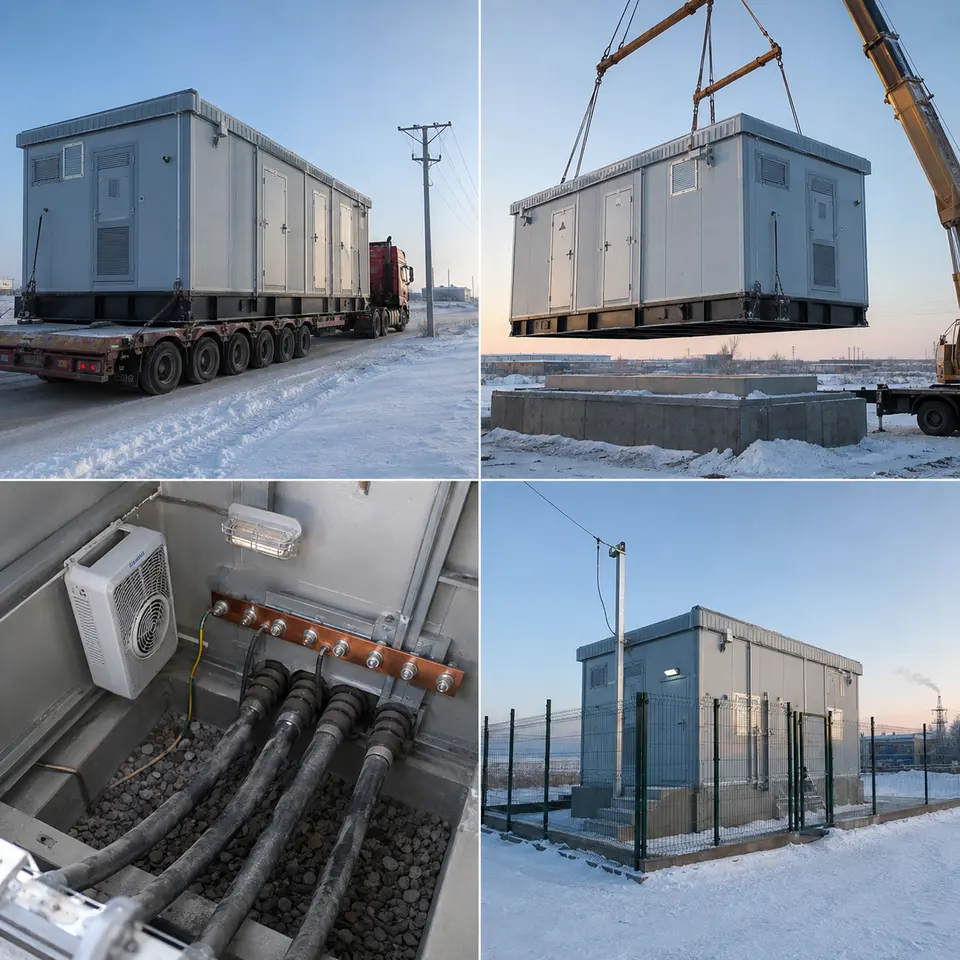
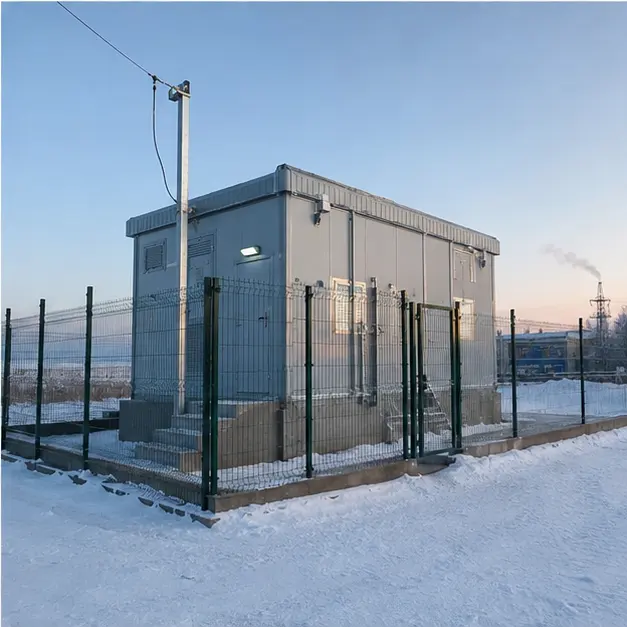
Reference configuration: 35 kV/10 kV thermally insulated prefabricated substation for remote industrial power supply in Kazakhstan — 35 kV incoming / 10 kV…
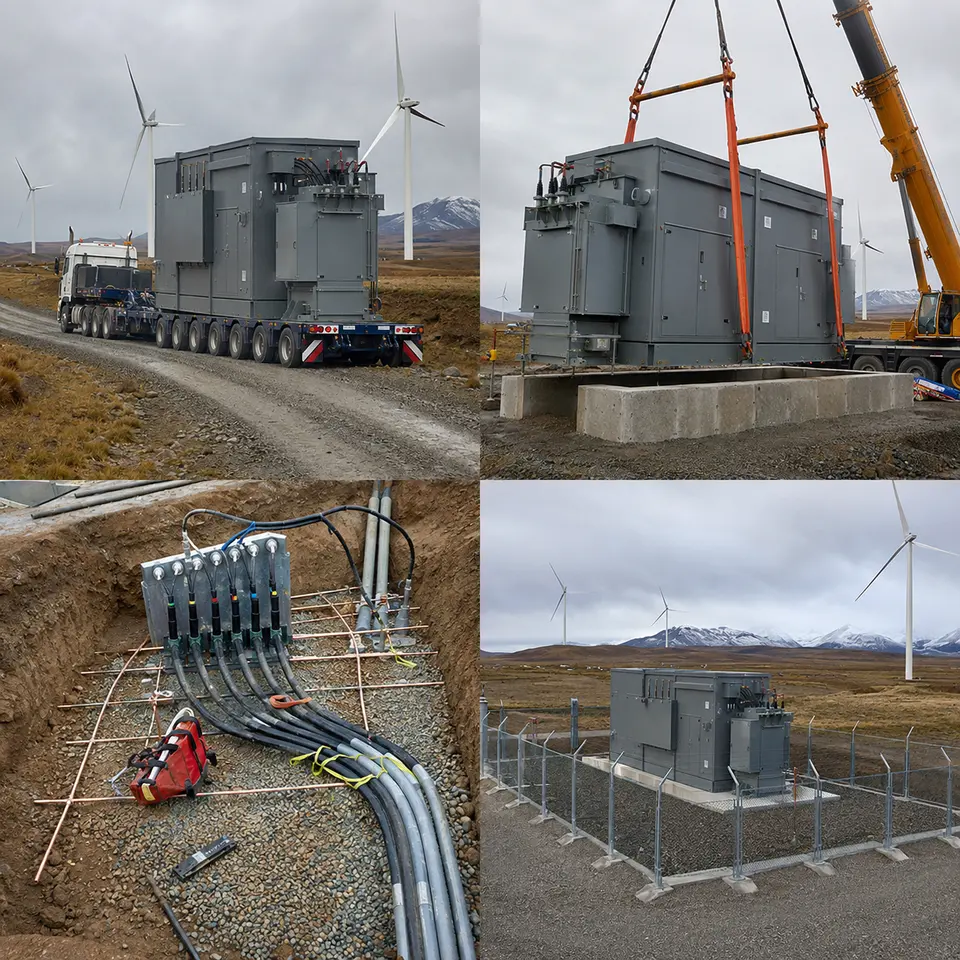
Four-stage sequence typical of a prefabricated substation used for 35 kV/10 kV cold-climate industrial supply in Kazakhstan
Representative project visualisation. Every image in this set is a representative visualisation of a typical build of this equipment class — none of them is a photograph or documentary record of a completed job, and none stands in for any specific customer, site, operator, utility, contract, commissioning date, or third-party sign-off. The ratings, quantities and layout shown here are illustrative starting points that would be pinned down against an actual enquiry.
IEC 62271-202 (prefabricated HV/LV substation), IEC 62271-1 and -200 for the switchgear including the low-temperature class, IEC 60076 series for the transformer, IEC 61439 for LV assemblies, IEC 60529 for ingress protection; GOST 15150 climatic version for the region and the EAEU technical regulations TR CU 004/2011 and TR CU 020/2011 for market access; Millenium holds an EAEU EAC declaration valid to 15 April 2029
What actually drives the specification in Kazakhstan is not the cold snap by itself but the full annual swing. A remote site can drop close to −40 °C in winter and climb toward +40 °C in summer, and that roughly 80-kelvin spread is a tougher brief than either extreme in isolation, since every material in the enclosure must remain inside its working range at both ends and survive being cycled between them repeatedly.
Sealing shows the problem most clearly. Elastomer gaskets grow stiffer as they near their glass transition point, and a compound picked mainly for heat resistance can take a compression set through the summer and then fail to hold contact pressure once winter arrives — at which point what was a sealed enclosure no longer is one. So the gasket material, the compression it is engineered for, and the differential expansion between steel, aluminium and the seal itself are all selected against the whole temperature band rather than against a single extreme.
The same reasoning carries through the electrical gear. SF6 turns liquid at a temperature set by its filling density, so switchgear intended for this duty relies on vacuum interruption, solid insulation, or an SF6 fill with a declared density and low-temperature class that keeps the gas in gas form throughout. Mechanism lubricants, cable insulation, battery capacity, display readability and moulded-case device behaviour all shift measurably once temperatures reach −40 °C.
What is left over is condensation risk. Warm, humid air let into a cold enclosure — or a cold enclosure warmed too fast — leaves moisture sitting on the insulation. Anti-condensation heating, controlled ventilation and sealed cable entries all exist to keep the internal dew point under the coldest surface temperature, and this is a year-round requirement, not something switched on only for winter.
System configuration
Item
Description
Specification notes
Enclosure
Thermally insulated prefabricated substation enclosure, skid or plinth mounted
Insulation thickness and thermal bridging sized to hold internal temperature at the specified heater load; roof profile and structure rated for local snow and wind loads; IP rating held across the full temperature range
Sealing system
Door, panel, louvre and gland-plate gaskets
Compound chosen for low-temperature flexibility and resistance to compression set across the whole annual range; compression set controlled by design rather than by fixings, with differential expansion between steel and aluminium accounted for
MV switchgear
35 kV incoming and 10 kV outgoing switching and protection
Vacuum or solid-insulated switching favoured for low-temperature duty; where SF6 is used, its filling density and minimum ambient class are stated; mechanism lubricants rated to the minimum temperature
Transformer
35 kV/10 kV transformer
Oil-immersed with low pour-point oil and a defined cold-start procedure, or cast-resin dry-type where cold-start behaviour and containment are the deciding factors; tapping range set against the network's voltage variation
Space and anti-condensation heating
Enclosure space heating plus panel and mechanism heaters
Heater load sized against enclosure heat loss at the minimum design ambient; anti-condensation heaters run from humidity and temperature signals rather than staying on continuously; a separate supply keeps heating alive through an outage of the main circuit
Ventilation
Controlled, thermostatically staged ventilation with snow-proof louvres
Ventilation carries away summer heat load while never admitting drifting snow or humid air during winter; louvre and filter design is worked out against both conditions
Cable entries
Sealed MV and LV entries through gland plates
Entries sealed against moisture, drifting snow and vermin; non-magnetic gland plates used for single-core cables; entry positioned above the expected drift line
Foundation and anchoring
Raised foundation designed for the local frost depth
Founded below the frost line, or built to a design tolerant of frost heave; a raised plinth keeps entries and floor above snow accumulation, and anchoring is engineered against wind loading on a tall enclosure
Auxiliary supply and monitoring
Auxiliary transformer, DC supply, heating control, temperature, humidity, door and alarm monitoring
Battery type and placement chosen for cold-weather capacity; remote monitoring reported over Modbus RTU/TCP, IEC 61850 or IEC 60870-5-104 given that a site of this kind is typically unmanned
Installation sequence
Overview — Four-stage sequence typical of a prefabricated substation used for 35 kV/10 kV cold-climate industrial supply in Kazakhstan
The contact sheet lays out the four stages typical of this kind of installation: winter transport, crane placement onto the raised foundation, cable-entry and anti-condensation work, and the finished, fenced installation. Cold weather narrows the working window at each stage, so sequencing follows what has to happen before frost or snow rule it out. Foundation, ducts and earth electrode are finished and verified before the ground freezes. Placement is timed for a window when the crane can be rigged and the enclosure set down without ice on the lifting points. Cable and sealing work happens inside a heated enclosure, with heating commissioned first, ahead of the internal work that depends on it.
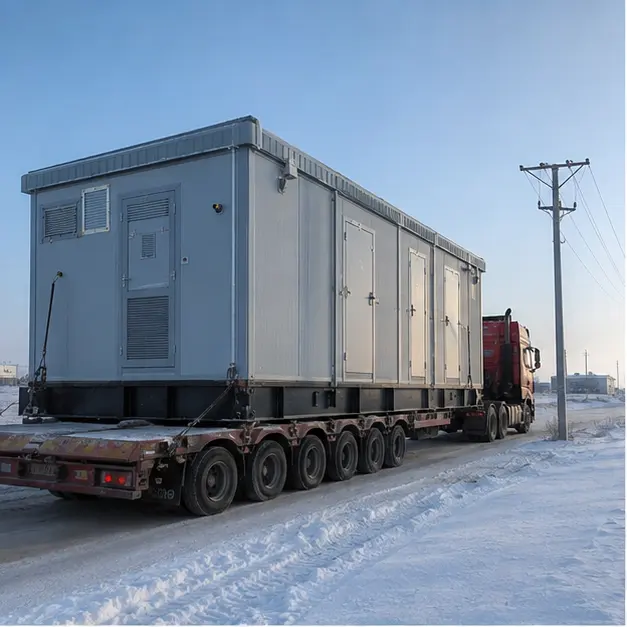
Delivery — Winter road transport of a prefabricated substation of this type to a remote industrial site
Winter road transport is first and foremost a load-securing challenge, scheduling second. Lashings loosen as steel contracts in the cold, so tension gets rechecked at intervals rather than set once and left. Braking distance on ice governs how routes are timed, and a tall enclosure with a high centre of gravity is vulnerable to crosswind on open steppe terrain. The equipment travels protected in its own right — transformer oil kept above its pour point, desiccant breathers sealed, and batteries or electronics either removed or carried in a heated space. On arrival the unit is checked before it is accepted: transport damage, seal condition, ice or snow ingress, and any shifted internal fixings. It is then allowed to equalise to ambient before enclosures are opened, since opening a cold panel into warmer air condenses moisture straight onto the insulation.
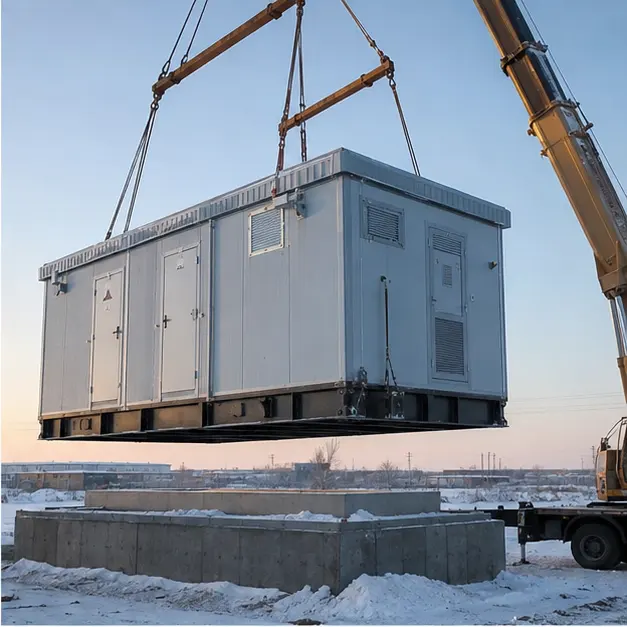
Placement — Crane placement of an insulated substation enclosure onto a raised foundation in winter conditions
Setting the unit down on its raised foundation is the critical lift, and the one most exposed to weather. Crane capacity gets derated for wind, and lifting stops above the wind limit rather than being judged by eye on site. Outrigger bearing pressure is assessed on ground that may be a frozen crust over soft material underneath — strong enough in the morning, not necessarily by afternoon. The lift uses the designated corner or lug points with a spreader beam so slings never bear on the insulated wall panels, which damage more easily than bare steel. Level is confirmed before the unit touches down, because an enclosure that is out of level distorts door seals and undermines the sealing that the entire thermal design depends on. Anchoring follows the wind and frost-heave detail exactly rather than being left approximate.
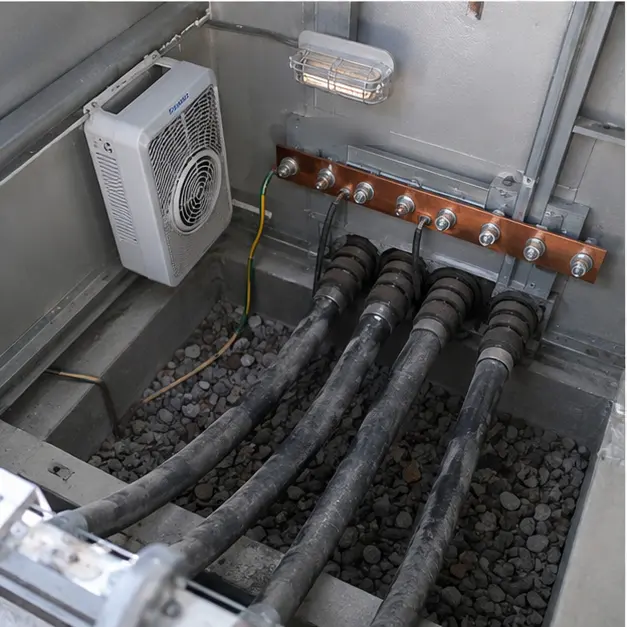
Internal work — Sealed cable entries and anti-condensation heating typical of a substation enclosure of this configuration
This is the stage that decides whether the enclosure stays dry for the rest of its service life. MV cable is warmed ahead of pulling, since XLPE stiffens in the cold and a cable bent below its minimum radius while cold can be damaged in a way that only surfaces later, as a termination failure. Terminations are made in a heated, dry space and finished within a single working period rather than left half-done overnight. Gland plates and entry seals are fitted so the enclosure's ingress rating carries through the entry point without a gap, and each entry is checked for any path that would let drifting snow reach the interior. Cable screens are bonded to the internal earth bar with a conductor sized for the earth-fault duty. Space and anti-condensation heaters, together with their thermostats, humidistats and separate supply, are then wired and functionally tested, and ventilation staging is set so it cannot pull humid air inside during a winter thaw.
Completed configuration — Completed configuration of a 35 kV/10 kV insulated prefabricated substation for cold-climate industrial supply
The finished configuration shows the substation fenced, sealed, insulated and labelled on its raised foundation. Ahead of energisation the installation is proved end to end: transformer ratio and vector group checked on every tap, insulation resistance recorded with the ambient temperature noted (since the reading depends on it), earth continuity confirmed from every enclosure part back to the main bar, and earth electrode resistance measured and logged along with ground condition, because frozen ground reads differently from thawed. Protection is proved by injection across the whole chain. Heating, ventilation, humidity control and any remote monitoring are checked functionally, including how they behave if the auxiliary supply is lost. Energisation happens in stages, and an oil-filled transformer is given the cold-start soak time its procedure calls for before load is applied.
Specification options
For a similar cold-climate enquiry, Millenium can adjust the voltage ratio and tapping range, capacity, vector group and impedance, offering either oil-immersed or cast-resin dry-type transformers with a cold-start procedure defined against the minimum ambient. Enclosures can be built to a stated thermal insulation performance, IP rating, corrosion category and coating class, with roof and structure rated for the site's snow and wind loading. Switching options span vacuum, solid-insulated or SF6 designs with a declared minimum ambient class and filling density. Heating can be provided as enclosure space heating plus panel and mechanism anti-condensation heaters, controlled by humidity and temperature on a dedicated supply, alongside thermostatically staged ventilation with snow-proof louvres. Sealed cable entries, low-temperature battery arrangements, cold-rated lubricants and displays, and remote monitoring over Modbus, IEC 61850 or IEC 60870-5-104 are all configurable, together with EAEU conformity documentation for the region.
What we need to quote
Single-line diagram of the incoming supply and the intended 10 kV distribution arrangement
Incoming 35 kV details, tapping range and step size, and the required vector group
Transformer capacity, site load profile and any motor starting or drive-fed load
System fault level at the point of connection, required withstand rating and clearing time
Protection philosophy, relay preferences and any utility-imposed settings or grading requirement
Minimum and maximum design ambient temperature, and the site's design snow and wind loading
Altitude, humidity range and the applicable GOST 15150 climatic version
Frost depth and ground conditions, and whether the foundation is raised or at grade
Auxiliary supply arrangement, required heating strategy and the acceptable heater energy consumption
Enclosure IP rating, thermal insulation requirement, corrosion category and coating specification
Communication protocol, remote monitoring points list and whether the site is unmanned
Conformity documentation required for import, site access route in winter conditions, permissible axle loading, crane availability and delivery terms
Quotation
Quote a comparable Kazakhstan project
Tick what you can already provide — it is added to your message — then send the inquiry. Missing items are not a problem; we will ask.